Makayla's Meadows
Irish D Porter - Cutting
Irish D Porter - Cutting
Couldn't load pickup availability
Irish D Porter was introduced in 2019 by Steve & Sandy Boley (of Birch Bay Dahlias, Whatcom County, Washington, USA).
Characteristics:
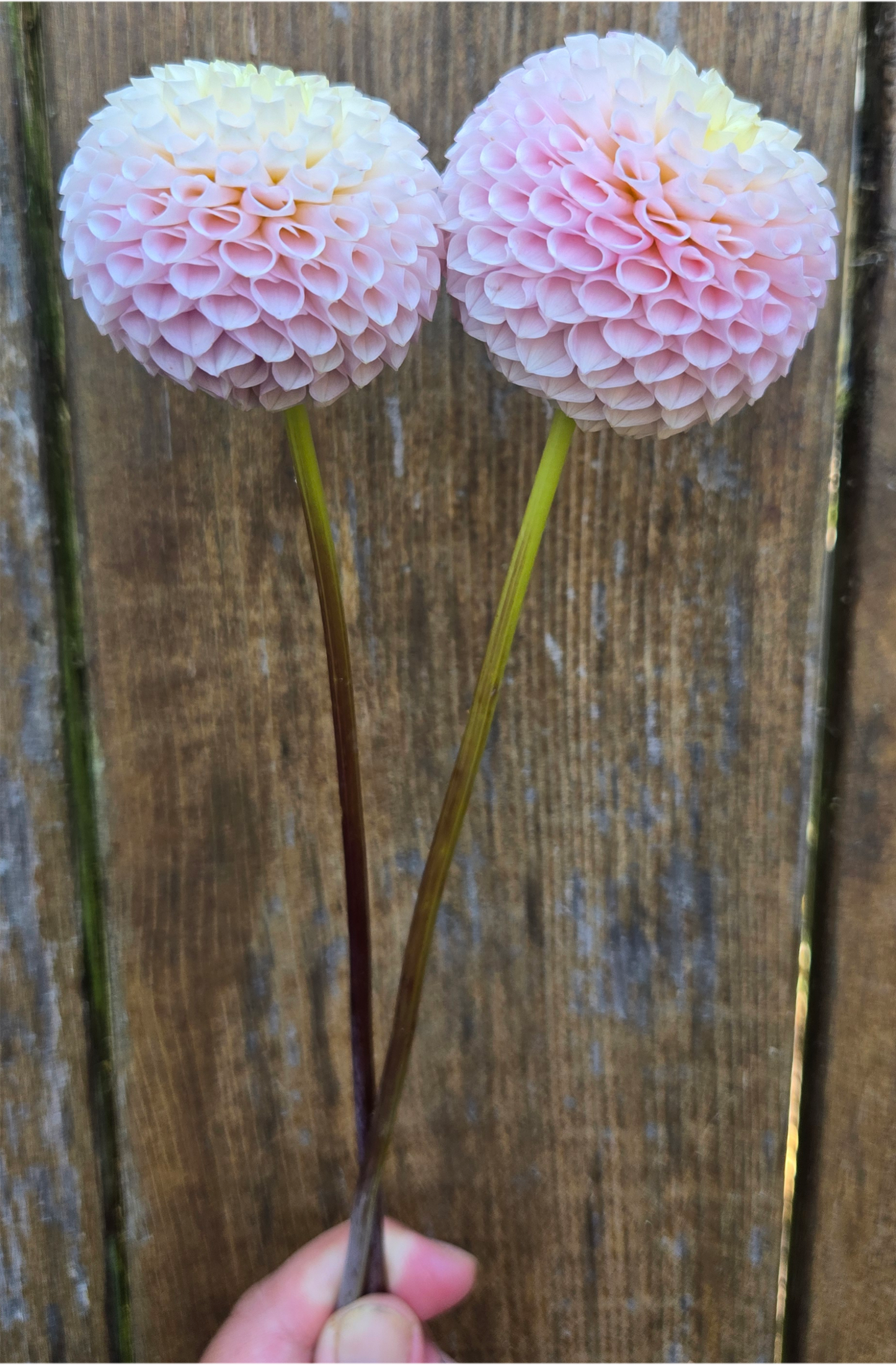
Form: Pompon (P). This variety exhibits a highly sought-after, symmetrical, and perfectly rounded ball shape. The petals are tightly involute (rolled inward), giving it a crisp, tidy appearance.
Color: Blush / Light Pink (PK). The petals are a beautiful, soft blend that often appears as champagne, delicate blush pink, or light cream with a pink wash.
- The center often retains a lighter, eggnog or light yellow tone, giving the bloom a soft inner glow.
- The color works flawlessly with cream and blush palettes, making it a favorite for wedding and market bouquets.
Bloom Size: Pompon size, meaning a small, petite bloom typically ranging from 1.5 to 2 inches (3.5 to 5 cm) in diameter.
Height: A robust plant that generally grows to 3 to 4 feet (90–120 cm) tall.
Performance:
- Cut Flower Quality: This variety is a champion cut flower. It is noted for being extremely productive (producing "oodles" of blooms) on long, sturdy stems that are excellent for cutting. Its diminutive size is perfect for adding texture and scale variation to mixed bouquets.
- Vase Life: Has a respectable vase life of around 5 days with proper harvesting and care.
-
Garden Use: Its neat habit and incredible production make it highly valued in cutting gardens. It is beloved by flower farmers for its reliability and its perfect blush tone, which is often difficult to achieve in dahlias.
Please note that the listing is for one rooted cutting.
-
We guarantee you will receive a cutting with a healthy root system at the time of receipt that is true to variety. Please examine your order immediately upon arrival and contact us via email (not social media) within 24 hours if you see an issue with your order. After 24 hours, the buyer accepts full responsibility for the tuber as we cannot be held responsible for improper storage, weather, growing conditions, pest damage, plant performance, failure to thrive or negligence.
Share